A Comparison of the Performance, Economic Feasibility, and Social Impacts of Different Sustainable Aviation Fuels
Updated: Sep 6

Author: Theodore Wang
Mentor: Antoine Thibaut. Antoine is currently a doctoral candidate in the High-Speed Turbomachinery Group in the Department of Engineering at the University of Oxford.
Abstract
In this review paper, sustainable aviation fuels are discussed as a solution to decarbonise aviation. This paper covers the motivation for sustainable aviation fuels in the context of climate change, technological challenges, production methods, performance factors, economical factors, social impact and the future projections for sustainable aviation fuels. The findings of this review demonstrate that sustainable aviation fuels have the potential to reduce nonvolatile emissions by 70%, reduce ice particles by 56% and reduce soot particles by 35%. This review paper is intended to motivate future research into sustainable aviation fuels as a method to reduce aircraft climate change impact.
Notation
ATJ AI ASTM BECCS DAC FAME FT GHG HEFA HTL IPK PtL SAF SPK | Alcohol-to-Jet Artificial intelligence American Society for Testing and Materials Bioenergy with carbon capture and storage Direct air-capture Fatty Acid Methyl Ester Fischer-Tropsch Greenhouse Gas Hydroprocessed Esters and Fatty Acids Hydrothermal Liquefaction Iso-Paraffinic Kerosene Power-to-Liquid Sustainable aviation fuel Synthetic paraffinic kerosene |
Introduction
Motivation for sustainable aviation fuels
Aviation accounts for nearly 2.4% of greenhouse gas emissions across the world (Schomakers, Engelmann & Ziefle, 2024). This percentage is expected to increase as air travel becomes more frequent. De-carbonising aviation represents a significant engineering challenge. Battery-electric aircraft struggle to reach the energy density of existing passenger aircraft powered by gas-turbines. Hydrogen aircraft present a CO2 neutral solution, however the infrastructure for storing and producing hydrogen is complex, expensive and introduces additional safety requirements. This makes hydrogen solutions a less favourable option for airlines making the investments into new aircraft. Additionally, hydrogen aircraft still produce water vapor and create nitrogen oxides (Khan et al., 2022). This implies that hydrogen aircraft have a net greenhouse effect. Sustainable aviation fuels offer a simpler alternative to these technologies which can use existing engine architectures and airport infrastructures.
Background into jet engine technology and bio fuel compatibility
Jet engines rely on burning a hydrocarbon (kerosene) to drive a turbine stage to power a fan or propeller. The most popular engine types powering modern aircraft are piston engines, turboprop engines and turbofan engines (Khujamberdiev & Cho, 2024). The six main engine types used in aviation are summarised in Figure 1. These include the turbojet, turbofan, turboprop, turboshaft, ramjet and scramjet engine architectures. The most common engine configuration used in commercial service is the turbojet.

The current literature is often focused primarily on the performance, social impact and economical factors involved in sustainability aviation fuels. In this review paper, the impacts are studied together to evaluate the suitability of different fuels in better context.
Method
In this study, review and research articles were considered to cover a wide range of sustainable aviation fuel technologies. The articles were found from peer reviewed journals. Articles between 2017 and 2025 were reviewed to cover a history of sustainable aviation fuels. Sources were selected with experimental and simulation data to understand the performance of blended and pure sustainable aviation fuels. Google Scholar was used as a search engine to find most research articles. The keywords used to search for new articles include the names of the different production methods used to extract sustainable aviation fuels and the types of sustainable aviation fuels.
Literature Review
In the following literature review, production methods, performance factors, economical factors, future developments and public opinions on sustainable aviation fuels are researched to identify current best practices.
Comparison of production methods
Algae-based SAFs
Algae-based sustainable aviation fuels (Algae SAFs) use microalgae or macroalgae biomass converted via HEFA (Hydroprocessed Esters and Fatty Acids) or HTL (Hydrothermal Liquefaction). In 2022, Cabrera et al. (Cabrera & Melo de Sousa, 2022) wrote a comparative literature review paper on the use of sustainable aviation fuels, including algae-based SAFs. During this process, two production processes can be utilized. On the one hand, HEFA extracts lipids from algae to process into drop-in jet fuel. On the other hand, HTL uses high heat and pressure on whole wet algae to create biocrude, a type of liquid synthetic fuel, without prior drying. This type of process, where a drop-in fuel is created, was determined by this paper to be more advantageous as they are more compatible with the aircrafts due to their similar chemical composition when compared to petroleum and fossil fuels.
Fischer-Tropsch process
The Fischer-Tropsch process is the process of heating up carbon sources like coal or natural gas with steam or oxygen to create a synthetic gas (syngas) mix of hydrogen and carbon monoxide which is then converted into liquid synthetic hydrocarbons. In 2022, Parker (Parker, 2022) conducted an investigation into the speed at which different Fischer-Tropsch processed fuels ignited and how well they burned. They burned small amounts of each fuel in a lab chamber, where they found that S8, a type of Fischer-Tropsch produced fuel, ignited the fastest and burned most efficiently. IPK burned more smoothly with less “knocking” (uneven burning). As a result, this experiment helped to uncover the different outcomes of using different feedstock sources for the Fischer-Tropsch process.
de Jong et al. (2017) conducted a life-cycle analysis of the greenhouse gas emissions from renewable jet fuel sources, including those produced via the Fischer-Tropsch process. In this experiment, it was discovered that according to the Well-to-wake (WtWa) life cycle assessment, the FT (Fischer-Tropsch) pathways achieved the highest GHG emission reductions compared to standard jet fuel, followed by hydrothermal liquefaction and sugar and corn-stover based ATJ. This further illustrated the differences in environmental impacts that result from using different production methods. The Fischer-Tropsch process is illustrated in Figure 2. The complete process from biomass to jet fuel is shown.

Hydrothermal Liquefaction (HTL)
Hydrothermal liquefaction (HTL) uses high heat and extreme pressure to convert wet organic waste into energy-dense bio-crude oil. This process ultimately mimics natural geological oil formation through three main stages being feedstock pressurization, thermal breakdown, and product separation. This energy dense liquid can be further refined into jet fuel. As well as studying the Fischer-Tropsch process, de Jong’s experiment in 2017 (de Jong et al., 2017) conducted a life-cycle assessment on the production process of hydrothermal liquefaction, ultimately determining that it is behind the Fischer-Tropsch process in GHG emission reductions. This illustrates how different production methods have different impacts on the environment.
Alcohol-to-jet (ATJ, sugarcane and corn stover-based)
Alcohol-to-Jet (ATJ) is a process that works by converting alcohols into sustainable aviation fuels through dehydration, oligomerization, and hydrogenation. These alcohols are very often plant- or waste- based, where sugars are fermented into alcohols like ethanol. During dehydration, water molecules are removed from the alcohol by chemical catalysts. Then, during the process of Oligomerization, smaller carbon molecules are linked together to form long hydrocarbon chains that fit the kerosene range needed for jet engine fuel. Finally, the stage of hydrogenation occurs, where hydrogen is added to stabilize and clean the fuel, making it a good drop-in replacement which can be blended with regular jet fuel (up to 50%). In de Jong's experiment in 2017 (de Jong et al., 2017), they also did a life-cycle assessment on Alcohol-to-Jet sugarcane- and corn stover-based fuels, determining that they have a similar GHG emission reduction to the hydrothermal liquefaction.
Sugar-to-jet
Sugar-to-jet is the process of forming long chain hydrocarbons from sugar. In 2023, Peters et al. (Peters, Alves & Onwudili, 2023) reviewed the performance of sugar-to-jet conversion processes. Sugar was identified as a good source for producing jet fuel due to a carbon and oxygen based composition. Suitable sugar sources identified were sugar beet, corn, wheat and sugarcane. The sugar can also be obtained synthetically from agricultural waste and other sources of biomass. Sulfuric acid is often used as a catalyst in this process. The biomass can ultimately be synthesised into C5 (pentose) and C6 (hexose) hydrocarbons for the biojet industry. Longer carbon chains ranging from C8 to C16 can also be achieved.
Lipids-to-jet (HEFA)
HEFA is the process of taking renewable lipid feedstock and refining it into a pure hydrocarbon product called HEFA-SPK (synthetic paraffinic kerosene). In 2023, Peters et al. (Peters, Alves & Onwudili, 2023) also reviewed the performance of the lipid-to-jet conversion process, evaluating the current possibility of its utilization as well as its long-term sustainability. During this process, oils and lipids are purified to remove any impurities that could damage the catalysts downstream, and then they are exposed to high temperature, intense pressure, and hydrogen to remove the oxygen forming water. This long hydrocarbon is then cut to prevent freezing and then distilled into separate cuts to yield the aviation fuel component. This review ultimately determined that the widespread use of the HEFA process is hindered by the feedstock availability and competition for food as well as changes in land use. Therefore, the trend to diversify the feedstock sources is growing and there is an understanding that non-food biomass resources can have a major role in biofuel production.
In 2022, Schripp et al. (Schripp et al., 2022) conducted an experiment that tested the non-volatile particle emissions from different HEFA blended SAFs compared to fossil fuels. This experiment was conducted with a ground-based engine, measuring the non-volatile particle number/mass as well as the gaseous emissions across a range of different power and thrust settings. Non-volatile particle mass emissions fell by up to 70% relative to the fossil reference fuel at the lower power settings. This reduction correlated with fuel hydrogen content and naphthalene content, making it more efficient to use. Ultimately, this experiment shows how the HEFA processed SAFs do in fact have positive impacts on the air quality and climate by reducing the overall emissions.
An HEFA lipid to jet process can take two pathways, the single-stage (Sour Mode) and the two-stage (Sweet Mode). The single-stage pathway is a much more cost-efficient pathway that skips the step of intermediate purification. However, skipping this step leaves intermediates like ammonia and hydrogen sulfide in the solution which can interfere with the metal catalysts in the process. On the other hand, the two-stage pathway removes the ammonia and hydrogen sulfide through intermediate purification. This results in a higher yield of SAF by going through the two-stage pathway. A typical lipid-to-jet industrial process is illustrated in Figure 3.

Whole-biomass-to-jet
Whole-biomass-to-jet fuel works by converting entire solid plant materials into liquid hydrocarbons. In 2023, Peters et al. (Peters, Alves & Onwudili, 2023) conducted a review of the current and emerging production technologies for biomass-derived sustainable aviation fuels, including whole-biomass-to-jet technology. This transforms raw organic matter into aviation-grade fuel using high heat, pressure, and chemical catalysts. During this process, raw plants are heated or treated with catalysts to dissolve the more tough plant fibers, turning them into liquid bio-oils or gases. Then, specialized chemical processes strip out unwanted oxygen atoms from the plant molecules using hydrogen gas. Hydrocarbon chains are rebuilt into the correct molecular size for jet engines. Though this process may have other issues, it has a high feedstock flexibility and efficiency, which makes it a highly promising technology.
Power to liquid (carbon-capture)
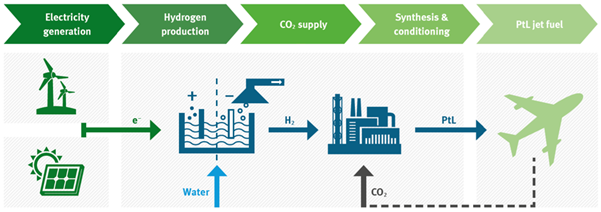
The power to liquid (PtL) process is a method of converting renewable electricity, water, and carbon dioxide (carbon capture) into a synthetic hydrocarbon aviation fuel. In 2018, Schmidt et al. (Schmidt et al., 2018) conducted a PtL processing via the use of methanol. Methanol is synthesized by going through the methanol-to-olefin conversion where methanol is dehydrated to form light hydrocarbons which are linked together via oligomerization and then hydrogenated into “drop-in” fuels, replacements for jet fuels. This process is very promising as it captures carbon from our environment and very closely resembles conventional jet fuels. Despite this, however, as an energy-intensive production process with extreme inefficiency it has not been widely adopted for use to create SAF. The power-to-liquid process is illustrated in Figure 4. The pathway from electricity generation to jet fuel is detailed. This consists of electricity generation, hydrogen production, supplying carbon dioxide, synthesis and final use as jet fuel.
Pyrolysis
Pyrolysis is a process that uses intense heat to bake raw materials without any oxygen. In 2025, Yang and Yao (Yang & Yao, 2025) conducted a meta-analysis of GHG emissions across SAF pathways, including pyrolysis. This process chemically breaks down raw materials into a liquid oil, gas, and charcoal, because with no oxygen present, there is no potential for it to catch fire, causing it to break down rather than burn. The material is blasted with extremely high temperatures, reaching 400-500 degrees celsius, in a sealed chamber with zero oxygen to prevent any combustion. This causes the biomass to be vaporized, creating vapors which are cooled into bio-oils to be used as fuel. Yang and Yao concluded that pyrolysis is a very efficient, low-cost production method, despite that it does not reach negative carbon emissions, due to the release of carbon from its combustion of co-products.
Performance of SAFs
The combustion of fuels in a jet engine produces nitrogen oxide, carbon dioxide, water vapor, sulfates, unburned hydrocarbons, soot and particles which contributes to global warming (Märkl et al., 2024). Sustainable aviation fuels have the potential to reduce these emissions while continuing to maintain engine performance. Blends of sustainable aviation fuels with conventional jet fuel can also be considered. SAF can make up 50% of the fuel content for modern jet engines without requiring aircraft or airport modifications (Märkl et al., 2024, Durdina et al., 2021). The performance of SAFs are mainly measured through the resulting particle and CO2 emissions, greenhouse gas effect, and contrails formation.
In 2021, Voigt et al. (Voigt et al., 2021) conducted in-flight measurements of different SAF's effect on soot and contrail ice formation. This compared low-aromatic HEFA-type SAF blends to standard jet fuel. Low-aromatic SAF blends contain less aromatics, complex ring structures that are difficult to break apart during combustion. On the other hand, conventional jet fuels contain significantly more aromatics, creating more potential for incomplete combustion and soot buildup. Therefore, as it was found in this study, burning low-aromatic SAF blends produced a 50-70% decrease in soot and contrail ice-crystal number concentrations. Contrails are harmful to our climate, as they trap heat in the atmosphere creating a warming effect that contributes to global warming. Therefore, this exemplifies how utilizing SAFs, particularly lower-aromatic SAFs, rather than conventional jet fuels can positively impact our climate and environment.
Similar experiments on a SAF HEFA blend were conducted by Durdina et al. (Durdina et al., 2021) in 2021 with a 32% SAF blend ratio. The test was conducted on a modern jet engine in a test cell at ground level. Downstream particle sizes and non-volatile particulate matter emissions were measured. Idle to take-off engine settings were investigated. The SAF mix was shown to decrease particle sizes at every engine condition. Non-volatile particulate matter emissions were reduced by 70% by mass at idle power with the SAF mix. This study shows how using SAFs can improve emissions and local air quality around airports closer to populations.
Experiments have been conducted more recently to compare the emissions of 100% SAF to conventional jet fuel. An in-flight test was reviewed in 2024 by Märkl et al. (Märkl et al., 2024) where contrails and particle emissions downstream of an aircraft powered by 100% HEFA sustainable aviation fuel were measured. The contrails and emissions were compared to an engine running conventional jet fuel. A 56% reduction in ice particles was measured relative to the conventional jet fuel. A 35% reduction in soot particles was also measured. The inflight test demonstrated with confidence that sustainable aviation fuels can significantly reduce aircraft emissions in cruise.
In 2022, Schripp et al. (Schripp et al., 2022) conducted a ground-based engine emissions testing across a range of SAF blend levels. HEFA-SPK blends of various ratios were compared with two fossil reference kerosenes, where the non-volatile particle number and mass emissions were measured as well as the gaseous emissions across a range of different thrust and power settings. These results were then compared to in-flight cruise-altitude data to make it simulate real life. Ultimately, it was found that non-volatile particle mass emissions fell by up to 70% relative to the fossil reference fuel at lower power settings. Similar to Voigt’s test in 2021, it was determined that the largest air-quality and climate benefits are achievable by minimizing complex aromatic content in SAF blends. Additionally, in terms of the correlation between blend level and emission reduction, this study determined that higher SAF blend ratios result in greater particulate reductions, but the effect is dependent on the power-setting. This reduction in emissions of 70% was at a low power setting, but that reduction trend decreases with increasing power settings, meaning the benefit of blending isn’t constant across an engine’s full range of operation. This clearly displays how low-aromatic SAFs have impressive environmental benefits, but still have clear limitations on their full implementation.
Another study on the contrail climate impact of SAFs was conducted in 2022 by Teoh et al. (Teoh et al., 2022). Performing a computer simulation study, researchers used computer models to simulate a whole region of real air traffic and worked to determine the best allocation of SAF fuels in different “what-if” scenarios to multiply the overall climate benefit. First, they measured the change in contrail properties and climate in the North Atlantic as they used six different blending ratios of SAFs, modeling several scenarios where a whole fleet used varying percentages of SAF blended with conventional jet fuel. During this experiment, researchers determined that across the 1%-100% range of blends, the benefit of SAF was not linear with blend concentration. A small amount of SAF used during the right flights was actually more beneficial than a larger amount spread evenly. Following this, they ran a second simulation where, rather than giving every flight the same blend, they modeled giving the limited SAF supply only to the specific flights that created the most warming contrails. Ultimately, they found that allocating the SAF supply could multiply its overall climate benefit by factors of 9-15 compared to simply spreading it out evenly. This demonstrates how the benefits of SAF use goes beyond the different blend ratios, and can be maximized by allocating SAF use properly.
Economics of SAFs
The introduction of sustainable aviation fuel represents challenges with agriculture, airport infrastructure and storage facilities which may have economical implications. The economical factors of power to liquid methods were reviewed by Schmidt et al. in 2018 (Schmidt et al., 2018). The price of installing a low temperature electrolyser was identified to have decreased by an order of magnitude for a given kW capacity between 2008 and 2018. The process efficiency of alcohol-to-jet and Fischer-Tropsch pathways were compared for direct air capture and concentrated source methods for 2018 and a prediction in 2050. The electricity to fuel conversion efficiency was highest for a concentrated source at 48% and 47% for the alcohol-to-jet and Fischer-Tropsch pathways in 2018 respectively. In 2050, the predicted efficiencies were 54% and 53% respectively. The review demonstrated a predicted increase in the efficiency of both processes, driving a reduction in the price of sustainable aviation fuels in future predictions.
As previously discussed, Yang and Yao’s meta-analysis of GHG emissions and production costs in 2025 (Yang & Yao, 2025) covered a wide variety of SAF pathways including Hydroprocessed Esters and Fatty Acids (HEFA), Fischer-Tropsch (FT), Bioenergy with carbon capture and storage (BECCS), Alcohol-to-Jet (ATJ), Pyrolysis, and Power to Liquid with direct air capture (PtL-DAC). After reviewing these pathways, it was determined that FT-BECCS, HEFA from used cooking oil, and PtL-DAC pathways achieved the most success, reaching negative GHG emissions. Economically, pyrolysis and HEFA showed the lowest production costs versus fossil jet fuel. As HEFA was proven to be a very cost-efficient and environmentally beneficial SAF, it demonstrates how HEFA is an excellent renewable fuel source. Furthermore, using all of this data reduced the uncertainty about these different pathways except for PtL-DAC where the hydrogen source remained the dominant uncertainty driver as hydrocarbons are a necessity.
Future projections for SAFs
In 2025, Kanwal et al. (Kanwal, Aslam & Torriero, 2025) reviewed emerging feedstock-engineering technologies for algae-based biofuel and SAFs. They surveyed advances in AI-driven strain optimization, genetic engineering, and nanotechnology-assisted processing. It was reported that genetic engineering and AI-guided strain selection majorly increased the lipid productivity by up to 40%. However, large scale commercialization of this technology remains constrained by the cultivation and downstream-processing costs. So while this technology seems majorly promising, without cost reductions, wide validation, and policy support, biodiesel from algae as a widely used fuel stays commercially out of reach in the near future. Instead, researchers suggest utilizing this technology to extract the co-products within the algae (proteins, pigments, fatty acids, and vitamins)–getting extra economic value out of the same batch of algae rather than using it purely for fuel.
Net-zero biofuel plants have been an area of interest for producing sustainable aviation fuels. In 2022, Yoo et al. (Yoo, Lee & Wang, 2022) reviewed the reduction in greenhouse gas emissions associated with a jet fuel plan utilizing renewable energy sources with carbon capture. The plant is designed to produce 170 million liters of SAF per year with a greenhouse gas reduction of 514,000 tons per year relative to a conventional energy source. This study demonstrated the reductions in greenhouse gas emissions that can be achieved by using renewable energy sources.
In 2024, Rowland et al. (Rowland et al., 2024) conducted an experiment where they tested the effect of an acid pretreatment on the oil yield and extracted-oil quality of algae strains. They tested this effect on multiple algae strains, one being a lower lipid content algae strain and one being a genetically modified algae with a higher lipid content. In both algae strains, the acid pretreatment increased both oil yield and extracted-oil quality. However, algae strains with lower lipid content had a lot of extra non-lipid material extracted, whereas the genetically modified algae with higher lipid content yielded more lipid with less waste–90% extraction yield with over 85% FAME purity (good for use). Overall, this study clearly displays how algae is a promising feedstock candidate for SAF as well as how acid pretreatment is a scalable step in the right direction. However, more work needs to be done on the purification side of the process before algae oil is truly ready to be adopted.
Public opinion
The public opinion for how well these SAF pathways can be implemented in industry vary greatly. One study that illustrates a viewpoint is Lai et al.’s study in 2022 (Lai et al., 2022), which tried to determine whether Sweden can realistically produce enough SAF domestically to hit its 2030 goals. This study looked at several different SAF production methods, assessing suitability in Sweden specifically. They assessed the environmental impact of each SAF pathway (life cycle assessments) and also looked at real-world factors like infrastructure and social/institutional support, to see which pathways Sweden could actually build at scale. It was concluded that some SAF pathways appeared environmentally friendly but could not be realistically scaled due to limited infrastructure or lack of institutional support. The study argues that being “green” is not enough because a pathway also needs to be practical to build. This study helps to illustrate how SAF pathways are considered when determining their place in the real world. Many SAF pathways look very promising, but as this study shows, there are a lot of other factors not shown in the data that must be considered before advancing their widespread implementation.
In 2025, Hong and Huh (Hong & Huh, 2025) conducted a survey to evaluate the consumer acceptance of SAFs and their willingness to pay for its implementation. This study surveyed 559 households in South Korea, using a method called Contingent Valuation, which measures how much people will pay for something that does not have a standard market price. Consumers stated that they are willing to pay an average of 10.7% more for a flight if it uses SAF rather than conventional jet fuel. This shows real public support for greener aviation rather than simply approval of the theory. Researchers in this study describe this as significant support. However, the paper also discusses how the public willingness to pay does not equate to the cost of producing SAF, meaning that this public support does not fully close the price gap. This paper ultimately frames consumer preference as a small piece of the puzzle along with government policy and production costs that will determine how quickly SAF will scale. The paper ultimately helps illustrate the growing public support for SAFs, despite the other limitations holding back its widespread adoption.
Discussion
Fuel comparison summary
Fuel comparison summary
The main five sustainable aviation fuel types and corresponding performance, production and economical factors are summarised in Table 1 below.
Fuel type | Performance factors | Production factors | Economic cost |
HEFA | Perhaps the most technologically mature pathway. Drop-in fuel that is compatible with many existing engines and infrastructure requiring little to no aircraft modifications. | Produced by hydroprocessing vegetable oils, cooking oils, and fats over catalysts. The availability of feedstocks is a constraint for producing on a large scale. | The cheapest SAF pathway currently. However, it is still more expensive than conventional jet fuels. The costs are trending downwards due to stabilizing feedstock costs and expanding production capacity as well as some public incentives to reduce costs. |
Sugar-to-jet | After engine testing, the amount of fuel consumption, gaseous emissions, and particulate matter emission was no different compared to conventional Jet A-1. | Fermentation of yeast converts sugarcane-derived plant sugars into a hydrocarbon molecule which is then hydrogenated and purified to make a fuel-grade hydrocarbon. This is then blended to produce the final fuel. Currently certified to be blended up to a maximum of 10%. | Sugar-based SAF can be cheaper when it is produced at an existing sugarcane mill rather than a standalone plant. One study discovered that sugarcane-residue fuel could potentially match jet fuel prices this way by sharing equipment and gaining extra revenue from the by-products. |
Algae-based | Algae-based jet fuels are still largely pre-commercial. Researchers claim it to be a “high-value niche” application. Costs are very high, higher than solar- or wind-derived alternatives even after efficiency gains. | Algae is still considered a fourth-generation feedstock. Advancements in genetic engineering, biorefinery integration, and improvements in cultivation are the main factors for its growth. | Production cost remains well above fossil diesel. Potential solutions to the issue of cost are algae-cement co-location and bioplastic co-production which could cut costs by up to 40%. |
Power-to-liquid | High conversion efficiencies are achievable via direct air capture, electrolysis, and Fischer-Tropsch synthesis. Fischer-Tropsch blends up to 50% are ASTM drop-in certified. | Combines CO2 capture, green hydrogen from electrolysis, and Fischer-Tropsch synthesis. Essentially, this combines captured CO2, electricity, and water into a liquid hydrocarbon. Building certain aspects of the machine that conducts this process, particularly the CO2-capturing machine, are very expensive and hard to build. | Power-to-liquid is currently the most expensive SAF pathway assessed. The price of hydrogen as well as the cost of machinery are large drivers to the overall cost. |
Alcohol-to-jet | Has a more broad application of different feedstock bases than HEFA. However, it needs to undergo more processes such as dehydration, oligomerization, and hydrogenation in order to meet jet-fuel specifications. | Ethanol or isobutanol is fermented from starch, sugar, or cellulosic biomass, and then chemically upgraded into jet fuel hydrocarbons. | The costs vary significantly, particularly depending on which feedstock is used. With ethanol derived from sugar or starch, it is cheaper than cellulosic biomass. These are both still more expensive than fossil kerosene. |
Table 1: Fuel types and corresponding performance, production and economical factors.
HEFA is the current gold standard sustainable aviation fuel in terms of price and performance, being technologically mature while being the cheapest SAF pathway.
Future research areas and testing requirements
This review paper has identified extensive efforts to experimentally measure emissions of aircraft powered by blends and 100% sustainable aviation fuels. To reduce the cost of these studies, future research may be required into simulation methods validated with experimental data. The cost of sustainable aviation fuel production can be reduced by improving the yield and electrical efficiency of the production pathways. The cost of the feedstocks and the conversion efficiency are major contributors to the overall price of SAFs. Therefore, yielding more usable fuel out of the same feedstock helps reduce costs. Additionally, when increasing the efficiency of the production pathways, it can be very beneficial to utilize waste heat within the plant, which can significantly cut costs. Another way to reduce these costs is to reduce the hydrogen and energy use during conversion as well as improving the catalyst performance. This can help reduce the amount of money spent on hydrogen, as well as speeding up the process through better performing catalysts. Even small efficiency gains like these can add up to a meaningful reduction in price.
Algae was identified as a potential source for sustainable aviation fuels. Algae is a promising feedstock because it does not interfere with food crops for farmland. However, the extraction process is currently wasteful for use in a pure jet-fuel processing method. Lower-lipid algae only yields 70-80% of its oil, with over 40% of that being impurities. Even higher-lipid algae strains only reach about 90% extraction yield, further research is recommended to process algae-based sustainable aviation fuel. This includes algae genetic engineering research, nanotechnology for improved extraction of aviation fuel and the use of artificial intelligence for strain selection for lipid extraction.
The effectiveness of sustainable aviation fuels for reducing climate change can be improved by increasing production energy content from renewable sources. SAF’s climate benefit depends not just on the fuel itself, but how the energy used to produce it is sourced. Using renewable energy sources such as solar and wind energy for steps like electrolysis can lower the overall carbon footprint of the fuel. Fuels that are made using fossil-powered electricity can potentially cancel out part of the climate benefits SAF is meant to create. Increasing this use of renewable energy across production pathways can greatly help SAFs reduce aviation’s climate impact by creating a net-zero energy process.
Conclusion
SAFs represent one of the most promising solutions for decarbonizing an industry that has been very difficult to be made electric. SAF offers a way to reduce the carbon footprint of aviation without the need of new engine designs or aircraft as most pathways produce drop-in fuel types which are compatible with existing engines. Unlike cars, which can be easily replaced with electric vehicles, commercial aircrafts have very long services which can make the process of building and designing new aircrafts extremely difficult and time-consuming. Drop-in SAFs avoid this problem entirely, as older and existing infrastructure can use SAF with zero changes to their design. This therefore portrays SAF as a realistic viable solution to decarbonize the aviation industry. To assess its potential, this paper examined SAF across multiple lenses including economics, performance, future projections, and public opinion. After taking all of these factors into account, it shows that SAF’s potential cannot only be judged on cost and performance alone. All of the factors that we examined determined whether a pathway will actually succeed at scale.
There are many different SAF pathways, and no single SAF pathway is a one-size fits all solution. Rather, the diversity of the pathways, including HEFA, sugar-to-jet, algae-based, alcohol-to-jet, and power-to-liquid, makes it possible for different production routes to be better suited to different feedstocks, infrastructure, and business models. For example, alcohol-to-jet and sugar-to-jet pathways are likely better suited to regions with larger existing agricultural or sugarcane industries, while HEFA better suits businesses with reliable access to hydroprocessing infrastructure and waste oils. This variety of usage is a strength rather than a limitation as it allows different companies, regions, and countries to pursue their own SAF pathway that best matches their available resources rather than trying to fit into a single global solution. One SAF pathway that stands out as the pathway with the most room to grow is the Algae-based SAF pathway. Currently, this pathway remains commercially immature. However, ongoing research in technology such as genetic engineering, nanotechnology, and AI-driven strain selection could become a significant driver in the expansion of this pathway. Therefore, continued investment into algae research presents a major opportunity to diversify and expand SAF production going forward.
References
AZoCleantech. (2013). The Fischer Tropsch process.
Cabrera, E., & Melo de Sousa, J. M. (2022). Use of sustainable fuels in aviation: A review. Energies, 15(7), 1–23.
de Jong, S., Antonissen, K., Hoefnagels, R., Lonza, L., Wang, M., Faaji, A., & Junginger, M. (2017). Life-cycle analysis of greenhouse gas emissions from renewable jet fuel production. National Library of Medicine, 10(1), 1–18.
Dingemans, J. (2024). How does a jet engine work? Understanding the 6 main types. Pilotswhoaskwhy. https://pilotswhoaskwhy.com/2024/04/21/how-does-a-jet-engine-work-understanding-the-6-main-types/
Durdina, L., Brem, B., Elser, M., Schonenberger, D., Siegerist, F., & Anet, J. (2021). Reduction of nonvolatile particulate matter emissions of a commercial turbofan engine at the ground level from the use of a sustainable aviation fuel blend. Environmental Science & Technology, 55(21), 14576–14585.
Hong, S., & Huh, S. (2025). Assessing the market viability of sustainable aviation fuel: Consumer acceptance and willingness to pay. Biomass and Bioenergy, 202, Article 108181.
ICAO. (2026). Power-to-liquid (PtL) for aviation. https://www.icao.int/SAF/stakeholder-action-groups-projects-power-liquid-ptl-aviation
Jalon. (2026). The HEFA process: A complete guide to SAF production—from chemistry to molecular sieve selection. https://www.jalonzeolite.com/hefa-process/
Kanwal, F., Aslam, A., & Torriero, A. (2025). Microalgae-based biodiesel: Integrating AI, CRISPR and nanotechnology for sustainable biofuel development. Emerging Topics in Life Sciences, 8(3), 131–143.
Khan, M. A. H., Brierley, J., Tait, K. N., Bullock, S., Shallcross, D. E., & Lowenberg, M. H. (2022). The emissions of water vapour and NOx from modelled hydrogen-fuelled aircraft and the impact of NOx reduction on climate compared with kerosene-fuelled aircraft. Atmosphere, 13(10), 1–12.
Khujamberdiev, R., & Cho, H. M. (2024). Biofuels in aviation: Exploring the impact of sustainable aviation fuels in aircraft engines. Energies, 17(11), 1–17.
Lai, Y., Karakaya, E., & Bjorklund, A. (2022). Employing a socio-technical system approach in prospective life cycle assessment: A case of large-scale Swedish sustainable aviation fuels. Frontiers in Sustainability, 3, Article 912676.
Märkl, R., Voigt, C., Sauer, D., Dischl, R., Kaufmann, S., HarlaB, T., Hahn, V., Roiger, A., WeiB-Rehm, C., & Le Clercq, P. (2024). Powering aircraft with 100% sustainable aviation fuel reduces ice crystals in contrails. European Geosciences Union, 24(6), 3813–3837.
Parker, L. H. (2022). Investigation of the low-temperature combustion phenomena of a Fischer-Tropsch synthetic aerospace fuel in a constant volume combustion chamber for greenhouse gas reduction [Honors thesis]. Honors College Theses, 1–53.
Peters, M., Alves, C., & Onwudili, J. (2023). A review of current and emerging production technologies for biomass-derived sustainable aviation fuels. Energies, 16(16), 1–40.
Rowland, S., Van Wychen, S., Dong, T., Leach, R., & Laurens, L. (2024). High-resolution lipidomics reveals influence of biomass and pretreatment process on the composition of extracted algae oils as feedstock for sustainable aviation fuels. Energy & Fuels, 38(7), 6547–6552.
Schmidt, P., Batteiger, V., Roth, A., Weindorf, W., & Raksha, T. (2018). Power-to-liquids as renewable fuel option for aviation: A review. Chemie Ingenieur Technik, 90(1–2), 127–140.
Schomakers, E. M., Engelmann, L., & Ziefle, M. (2024). Diversity in the acceptance of sustainable aviation fuels: Uncovering varying motivational patterns. Fuel Communications, 20, Article 100129.
Schripp, T., Anderson, B., Baudier, U., Rauch, B., Corbin, J., Smallwood, G., Lobo, P., Crosbie, E., Shook, M., & Miake-Lye, R. (2022). Aircraft engine particulate matter emissions from sustainable aviation fuels: Results from ground-based measurements during the NASA/DLR campaign ECLIF2/ND-MAX. Fuel, 325, Article 124786.
Teoh, R., Schhumann, U., Voigt, C., Schripp, T., Shapiro, M., Engberg, Z., Molloy, J., Koudis, G., & Stettler, M. (2022). Targeted use of sustainable aviation fuel to maximize climate benefits. Energy and Climate, 56(23), 17246–17255.
Voigt, C., Kleine, J., Sauer, D., Moore, R., Brauer, T., Le Clercq, P., Kaufmann, S., Scheibe, M., Jurkat-Witschas, T., & Anderson, B. (2021). Cleaner burning aviation fuels can reduce contrail cloudiness. Communications Earth & Environment, 2(1), 1–10.
Yang, F., & Yao, Y. (2025). Sustainable aviation fuel pathways: Emissions, costs, and uncertainty. Resources, Conservation and Recycling, 215, Article 108124.
Yoo, E., Lee, U., & Wang, M. (2022). Life-cycle greenhouse gas emissions of sustainable aviation fuel through a net-zero carbon biofuel plant design. ACS Sustainable Chemistry & Engineering, 10(27), 8725–8732.


Comments